
Most leadership development programs end with a survey. Satisfaction scores come back strong, the facilitator gets re-booked, and six months later no one can point to a single operational result that changed. That gap isn’t a training problem — it’s a measurement problem.
Closing that gap requires connecting leadership development ROI to the business outcomes executives already track: retention, throughput, decision speed, cost per error. When you build that connection before training begins — not after — the numbers become defensible and the investment becomes repeatable.
This guide gives you a step-by-step framework to do exactly that. By the end, you’ll know how to establish a baseline, choose metrics that hold up to scrutiny, isolate the effect of development from other variables, and present results in a format that earns the next approval.
Start With a Business Case, Not a Budget Request
Leadership development programs fail to earn sustained investment for one consistent reason: they are pitched as training expenses rather than operational solutions. Before a budget conversation happens, executives need a business case — one that connects the proposed investment directly to a problem leadership already owns and is accountable for solving.
That means starting with the operational problem, not the curriculum. Is your senior manager pipeline too thin to absorb planned growth? Are service delivery errors climbing because supervisors lack structured decision frameworks? Is voluntary turnover in a critical function eroding margin? Name the problem precisely, quantify its current cost where you can, and confirm that the right sponsor agrees it is a priority worth solving.
Frame the problem in finance’s language
Define success in terms your CFO and COO will recognize:
- Margin — reduced rework, overtime, or error-correction cost
- Retention — lower replacement and onboarding spend per position
- Throughput — faster cycle times or improved capacity utilization
- Risk — fewer compliance gaps, escalations, or operational failures
This framing is the foundation of measurable leadership development ROI. When the problem statement is written in operational and financial terms, you create the conditions to actually measure whether training moved the needle.
Get sponsor sign-off on that problem statement before a single learning objective is written. Executive leadership strategy built without that agreement produces programs that are well-designed and invisible to the people who fund them.
Establish Your Operational Baseline Before Training Begins
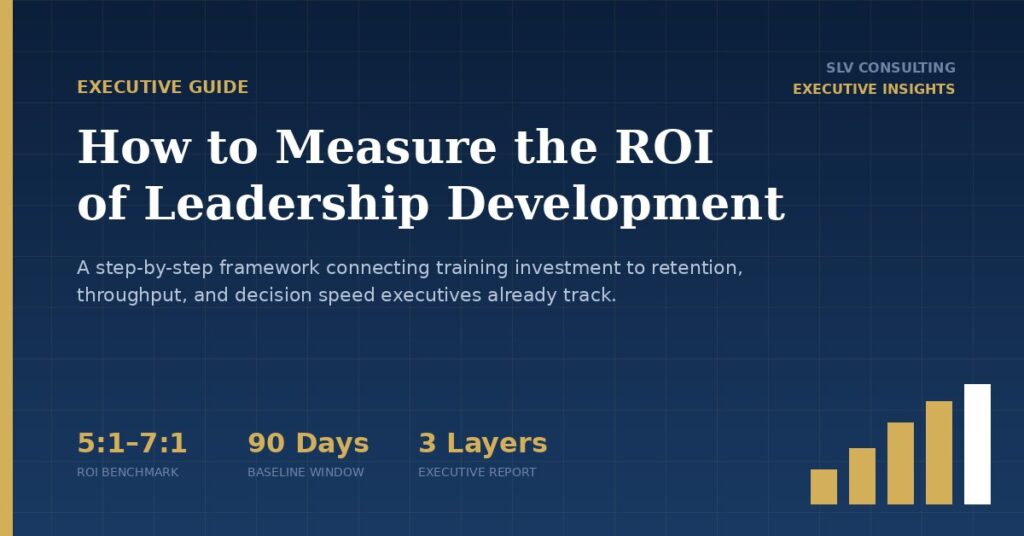
Before any program launches, pull 90-day averages for every metric tied to your problem statement. If you identified slow decision-making as the core issue, you need current data on decision cycle times, escalation frequency, and the number of decisions that required senior intervention. If the issue is team performance, document output rates, error frequency, and completion rates against target. These numbers are your anchor.
What to capture before day one
- Decision velocity — how long it takes a leadership layer to move from problem identification to authorized action
- Escalation frequency — how often decisions that should be made at one level move up the chain unnecessarily
- Team performance indicators — output, quality, and deadline adherence metrics relevant to the leaders being developed
- Turnover and engagement signals — absenteeism, voluntary exits, and internal transfer requests within the affected teams
This is the unglamorous part of leadership development & training, and it is also the most consequential. Without a pre-training baseline, you cannot isolate what changed, and you cannot attribute results to the program. A meaningful leadership development ROI calculation starts here — not after the final session.
Document everything in writing, with timestamps and data sources noted. When you return to these numbers six months later, the rigor you built in now is what turns a performance observation into a defensible business result.
Choose Metrics That Executives Will Actually Act On

Executives sign budgets based on outcomes. If the metrics you bring them measure activity — courses completed, hours logged, attendance rates — you’ve already lost the conversation. Those numbers tell a sponsor that training happened. They don’t tell anyone whether it worked.
Start with lagging indicators that connect directly to how the organization is measured. Revenue per leader and voluntary turnover rate are reliable anchors because they sit inside existing operational reporting. A CFO already knows what turnover costs. A COO already tracks output per business unit. When leadership ROI metrics map to data your sponsors already own, attribution becomes a conversation rather than an argument.
One Leading Indicator Per Cohort
Lagging indicators confirm what happened after the fact. To give executives an earlier read, add a single leading indicator per cohort — 360-degree feedback score movement is the most practical choice because it captures behavioral shifts while a program is still in progress. One leading metric is enough. Adding more dilutes focus and creates a reporting burden that rarely gets sustained.
Executive performance indicators worth tracking include:
- Voluntary turnover rate among direct reports within the leader’s span of control
- Revenue or output per leader, normalized to team size
- 360 score movement from baseline to end of program
- Internal promotion rate for leaders who completed development programming
Pick two or three that match your organization’s existing KPIs. Consistency across reporting cycles matters more than a comprehensive list.
Build the Measurement Chain From Learning to Business Outcome
Metrics without a clear causal path are anecdotes. The work in this section is structural: you are building a chain where every link connects learning to behavior to operational result — and the chain has to hold under scrutiny.
Start by mapping each competency taught to a specific workflow decision the learner owns. Not a general capability, a specific decision. A director who completes a course on operational prioritization should be making identifiable choices differently — which requests get escalated, which projects get resourced first, how capacity constraints get communicated up. If you cannot name the decision, you have not yet defined the competency precisely enough to measure it.
Trace the Handoff Point
Every behavior change has a handoff moment where it converts into an operational result. A manager who now runs tighter project reviews reduces rework. A team lead who improves delegation frees senior capacity. That handoff — where the individual’s changed behavior touches a process your organization already tracks — is where leadership impact chain analysis earns its value. Document it before training begins, not after.
A broken link anywhere in the chain makes the ROI math indefendable. If the learner changed behavior but the workflow was not set up to capture it, you will not be able to attribute the outcome. That is a design failure, not a measurement failure.
This is the discipline that separates leadership development & training built for accountability from programs designed only to be delivered.
Collect, Isolate, and Attribute Results Honestly
Data collection without isolation is just storytelling. Before you report any result, you need a defensible answer to one question: how much of the change came from the training, and how much came from everything else?
The most practical method for most organizations is trend-line isolation. Pull 12 to 18 months of pre-training performance data, establish the trajectory, then measure post-training results against that baseline projection — not just against a prior-period snapshot. Where you can run a control group of comparable managers who did not participate in the program, do it. The comparison gives your leadership development ROI calculation something it rarely has: a credible counterfactual.
Behavioral data is a separate collection stream. Survey direct managers at 30, 60, and 90 days post-program using structured questions tied to the observable behaviors you defined before training began. Ask what they see, not what they believe. Sentiment drifts; behavior is reportable.
Disclose What You Cannot Control
Confounding factors — a leadership transition, a budget cycle, a reorganization — should be named in your report, not buried. An honest disclosure of isolating training impact from other variables does more for your credibility than a clean number that no one believes. Senior decision-makers who fund the next program need to trust the methodology, not just the headline figure. Give them the methodology. The number follows from that.
Report ROI in a Format That Earns the Next Budget Approval
The moment you walk into a budget conversation leading with course completion rates or satisfaction scores, you’ve already lost the room. Lead with dollar impact. State the total measurable benefit, subtract the fully loaded program cost — including design, delivery, participant time, and any lost productivity — and present the ratio plainly.
A clean leadership development ROI statement reads like this: For every dollar invested, the program returned X dollars in measurable operational value. Then you show your work.
Structure the Executive Summary in Three Layers
- The number. Total benefit divided by total cost, expressed as a ratio and a dollar figure.
- The evidence. Two or three operational metrics that moved — retention, time-to-competency, error rates, throughput — tied directly to the baseline you established before training began.
- The attribution. A brief, honest account of what you isolated and what you excluded, so the figure is defensible under scrutiny.
Attach a one-page methodology document as an appendix. It should capture your baseline sources, measurement timeline, isolation method, and cost accounting approach. That single page is what converts a one-time report into a repeatable system — the next cycle runs faster, the results are comparable, and leadership investment justification becomes a process rather than an annual scramble.
ROI reporting executives trust is built on specificity, not confidence. Precision earns the next approval.
Frequently asked questions
How do you calculate the ROI of a leadership development program?
Establish operational baselines before training begins — retention rates, promotion velocity, team performance scores, revenue per manager. After the program, measure the delta. Tie each metric to a dollar value using your existing finance methodology. ROI follows from the gap between cost and quantified outcome change.
What metrics should HR use to measure leadership training effectiveness?
Focus on metrics that connect to business outcomes: internal promotion rates, time-to-competency for new leaders, manager-driven attrition, team productivity, and 360-degree assessment scores. Track them at 30, 90, and 180 days post-program. Sentiment surveys matter less than operational data your CFO will recognize.
How long does it take to see ROI from executive coaching?
Behavioral change shows in 60–90 days. Operational impact — improved team retention, faster decisions, stronger cross-functional execution — typically registers in two to three quarters. Coaching tied to a specific business problem, not generic development, compresses that timeline considerably.
What is a good ROI benchmark for corporate leadership development?
Industry studies suggest a 5:1 to 7:1 return on well-structured programs, but benchmarks are less useful than your own baseline. A program aligned to a defined operational gap — a stalled strategy, a succession risk, a performance plateau — will produce measurable returns you can defend internally.
Where to go from here
Measuring leadership development ROI is ultimately a business decision, not a training exercise. When you connect learning outcomes to operational baselines, isolate the variables honestly, and report in terms executives recognize, the measurement chain becomes the case for continued investment. That discipline is what separates programs that get renewed from programs that get cut.
If you’re building or rebuilding a leadership development function and want a framework grounded in operational practice — not theory — SLV Consulting works directly with executive teams to design, deliver, and measure programs against real performance targets. Explore our leadership development & training services to see how we approach the work.